

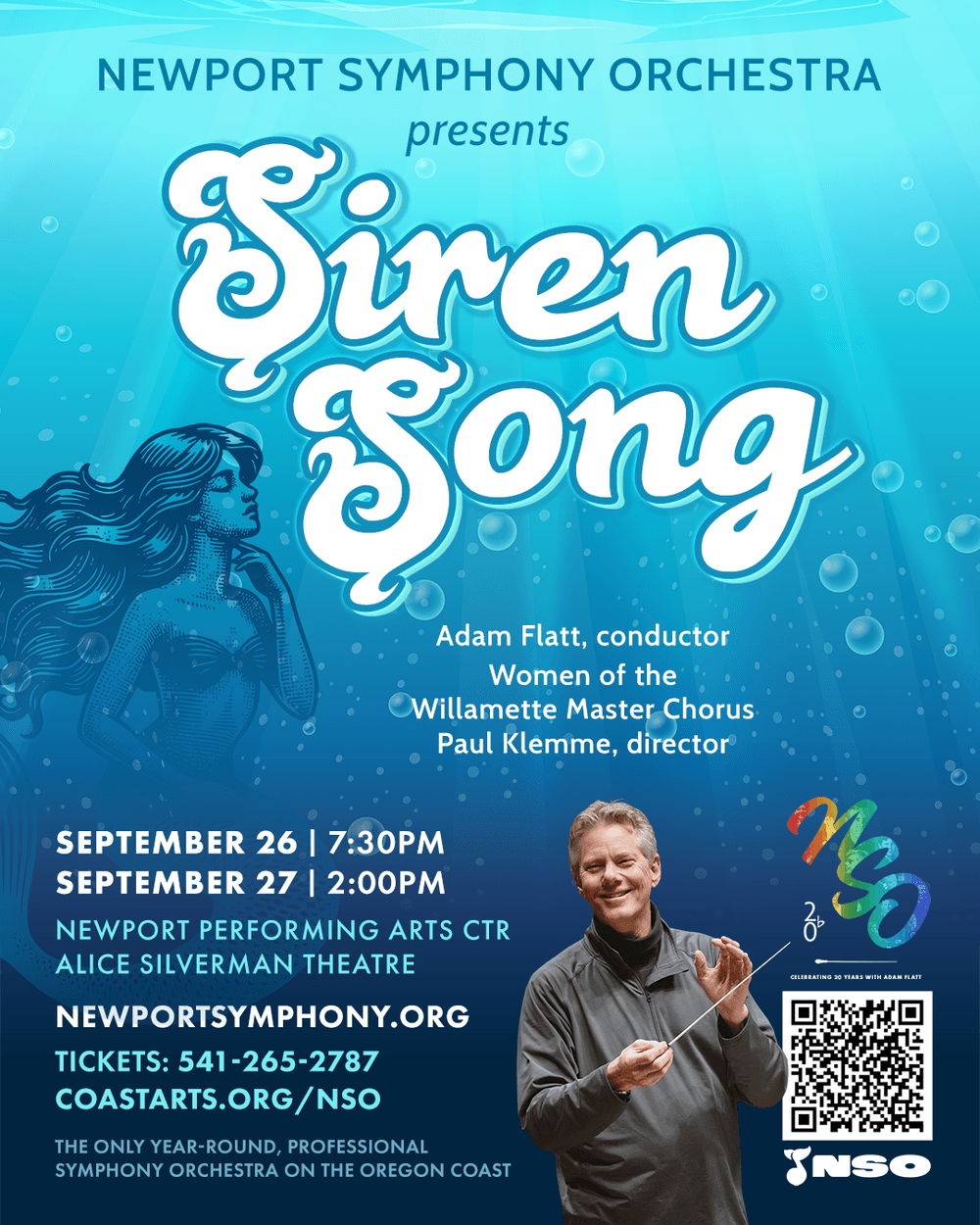
Siren Song
Presented in Partnership with Music is Instrumental
September 26th, 2026 @ 7:30pm - Preconcert chat at 6:45pm
September 27th, 2026 @ 2:00pm
Adam Flatt, conductor
Women of the Willamette Master Chorus*
Paul Klemme, director
Get your tickets today! (541)265-2787 or online at coastarts.org/nso
Claude Debussy
Nocturnes*
Robert Lowry
"How can I keep from singing?"
Women of the Willamette Master Chorus*
- - INTERMISSION - -
Jessie Montgomery
Coincident Dances
Igor Stravinsky
Suite from The Firebird (1945)
Claude Debussy, Nocturnes, L. 98
3 flutes (3rd doubling piccolo), 2 oboes, 1 English horn, 2 clarinets, 3 bassoons, 4 horns, 3 trumpets, 3 trombones, 1 tuba, timpani, cymbals, snare drum, women’s chorus, 2 harps, and strings
Last performed on October 7th, 2000, and conducted by Sylvain Frémaux
The three movements of Debussy’s Nocturnes for orchestra were composed between 1897 and 1899. The composer’s choice of words, “Nocturnes,” as the title of the three-movement suite largely reflects his new outlook. What he wanted to avoid was any connection with traditional Germanic concepts of sonata, symphony, and the like. He sought a new, flexible title that was basically neutral. So, he used a term that goes back in musical history to compositions that originally evoked the night, but later came to refer to groups of movements intended to be played outdoors by an ensemble as a kind of serenade. Debussy’s three movements are entitled Nuages, Fêtes, and Sirènes.
Nuages (clouds) depicts the serene, immutable floating of clouds in the sky, a delicate study in the infinite varieties of grays and white.
The second movement, Fêtes (festival), depicts just that, but not one that should evoke a specific place and time, rather the idea of a universal one, with dancing rhythms and splashes of comet-like light. A sonorous procession (listen for the muted trumpets) interrupts in the middle, but the splashy, vivacious mood of the beginning returns.
The last movement, Sirènes, is a seascape, replete with a wordless women’s chorus that depicts the Sirens, the alluring bird-women, who seduce unwary sailors to death and destruction. Debussy frequently treated the human voice as a unique addition to the palette of orchestral colors, and this is yet again more evidence of the supreme imagination by which French composers exploited and enlarged the resources of the orchestra. The undulating rhythms of the sea combine with the shimmering sound of the Sirens’ song to complete the trilogy.
© 2015 William E. Runyan
Robert Lowry, “How can I keep from singing?”
Performed by the Women of the Willamette Master Chorus
Text:
My life flows on in endless song,
above earth’s lamentation.
I catch the sweet, though far-off hymn
that hails a new creation.
Refrain:
No storm can shake my inmost calm
while to that Rock I’m clinging.
Since Love is lord of heav’n and earth,
how can I keep from singing?
Through all the tumult and the strife,
I hear that music ringing.
It finds an echo in my soul.
How can I keep from singing? [Refrain]
What though my joys and comforts die,
I know my Savior liveth.
What though the darkness gather round?
Songs in the night he giveth. [Refrain]
The peace of Christ makes fresh my heart,
a fountain ever springing!
All things are mine since I am his!
How can I keep from singing? [Refrain]
Robert Lowry was a Baptist minister and hymn writer who preached throughout Pennsylvania and New Jersey. He’s best known for his song, “Shall we gather at the river,” which was written in 1864 during a killer heat wave that caused many deaths. Unfortunately, not much is known about the history of “How can I keep from singing?”, except that the text speaks words of comfort throughout the joys and trials of life. Lowry reminds us that, for Christians, we have faith in the much larger reality of our sovereign Lord, who has redeemed the world and who will one day return for us.
© Rob Durocher
Jessie Montgomery, Coincident Dances
1 flute, 1 piccolo, 2 oboes, 1 clarinet, 1 bass clarinet, 2 bassoons, 2 horns, 2 trumpets, 3 trombones, 1 tuba, timpani, bass drum, caxixi, cowbell, hi-hat, shaker, snare drum, suspended cymbal, tambourine, timbales, toms, triangle, woodblock, xylophone, strings.
Coincident Dances is inspired by the sounds found in New York’s various cultures, capturing the frenetic energy and multicultural aural palette one hears even in a short walk through a New York City neighborhood. The work is a fusion of several different sound-worlds: English consort, samba, mbira dance music from Ghana, swing, and techno.
My reason for choosing these styles sometimes stemmed from an actual experience of accidentally hearing a pair simultaneously, which happens most days of the week, walking down the streets of New York, or one time when I heard a parked car playing Latin jazz while I had rhythm and blues in my headphones. Some of the pairings are merely experiments. Working in this mode, the orchestra takes on the role of a DJ of a multicultural dance track.
© Jessie Montgomery
Igor Stravinsky, Suite from The Firebird (1945)
2 flutes (the second doubling piccolo), 2 oboes (the second doubling English horn), 2 clarinets, 2 bassoons, 4 horns, 2 trumpets, 3 trombones, 1 tuba, timpani, triangle, cymbals, tambourine, snare drum, bass drum, xylophone, harp, piano, strings.
The works of Stravinsky consistently exhibited a remarkable seriousness of purpose, solid musical integrity, and benchmark imagination. His genius made its mark early; there are almost no compositions that we can label “journeyman” or “youthful apprentice works.” Born into a musical, middle-class family, he studied law, music theory, and composition simultaneously. By his mid-twenties, he had begun to concentrate on music, rather than law, and had composed only a few works that were heard publicly. But that led to his historic encounter with Sergei Diaghilev.
The cutting edge of the ballet world for most of the early twentieth century was the Ballets Russes of Diaghilev in Paris and Monte Carlo. Under the artistic leadership of Diaghilev, this company was responsible for the creation of artistic works whose influence continues unabated today. Which makes it even more remarkable that, for the first season of ballet, Diaghilev chose the relatively unknown Igor Stravinsky. In 1909, Diaghilev had attended a concert in St. Petersburg, where two of the young composer’s few works were performed. Thoroughly impressed, Diaghilev commissioned Stravinsky to provide music for the 1910 ballet season in Paris.
The ballet opens in Kashchei the Immortal’s magical realm; Prince Ivan enters and soon spots the luminous Firebird. He sees thirteen captured princesses, who are dancing a round dance, and, of course, immediately falls in love with one of them. The evil Kashchei rebuffs the Prince’s request for his chosen one’s release, and a fracas ensues, with Kashchei’s grotesque minions in the attack on the Prince. The Firebird intervenes, casts a spell over Kashchei’s followers, and they are compelled to dance frenetically. They ultimately collapse into sleep to a lullaby, but soon Kashchei awakens, and another dance ensues. The Firebird tells the Prince how to slay Kashchei by destroying the giant egg in which his soul resides. He does so; the whole evil kingdom, Kashchei, and his magic all disappear. The sun breaks forth, and a general celebratory apotheosis triumphs.
As Debussy is reputed to have wryly remarked, “Well, you’ve got to start somewhere.”
© 2016 William E. Runyan