
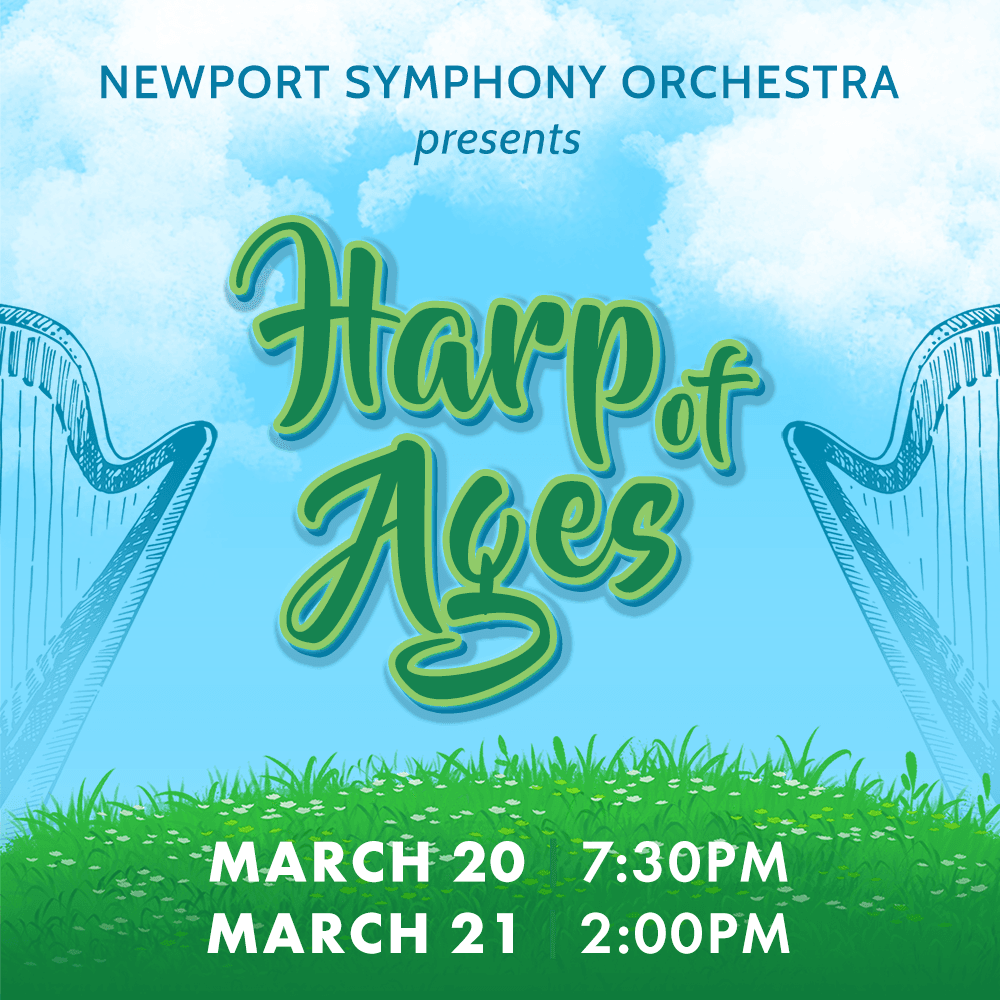
Harp of Ages
Presented in Partnership with Yakona Nature Preserve & Learning Center
March 20th, 2027 @ 7:30pm - Preconcert chat at 6:45pm
March 21st, 2027 @ 2:00pm
Adam Flatt, conductor
Courney Hershey Bress, harp*
Get your tickets today! (541)265-2787 or online at coastarts.org/nso
Walter Piston
The Incredible Flutist
Michael Daugherty
Harp of Ages*
Courtney Hershey Bress, harp
- - INTERMISSION - -
Pyotr Ilyich Tchaikovsky
Symphony No. 5 in E minor, Op. 64
Walter Piston, The Incredible Flutist
2 flutes, piccolo, 2 oboes, 1 English horn, 2 clarinets, 1 bass clarinet, 2 bassoons, 1 contrabassoon, 4 horns, 3 trumpets, 3 trombones, 1 tuba, timpani, castanets, cymbal, bass drum, glockenspiel, snare drum, tambourine, triangle, piano, strings.
Last performed on January 24th, 2009, and conducted by David Ogden Stiers.
In 1938, Walter Piston wrote his only ballet, The Incredible Flutist. The Boston Pops under Arthur Fiedler commissioned and premiered it on May 30th, 1938. The libretto for the story was created by Piston with the choreographer and dancer Hans Wiener. The ballet was made into an orchestral suite in 12 parts, which was immediately recorded by the Boston Pops in 1938 and received its live performance premiere in 1940 with the Pittsburgh Symphony, led by Fritz Reiner.
The story is set in a small village when the market and the circus come to town. It could be, as reviewer Elliott Carter noted, ‘any village’. Piston avoided using any national styles in the music to give it this everywhere/anywhere quality. The piece opens in a small village with the opening of the market on a sleepy afternoon. Vendors (strings and winds) set up the stalls, and with a flourish of horns and a trumpet, the customers arrive. As is common in a ballet, various character dances follow, including the Tango of the Four Daughters. This is an accent switching piece that moves in quintuple meter, switching between two-three and three-two at the cadences. It has a Spanish-flavored middle section before returning to the tango.
The circus comes to town with trumpets and horns, quickly forming into a Circus March, complete with a cheering mob supplied by the orchestra members; it closes with a barking dog. The incredible flutist of the title comes in the 7th movement, where he turns out to be a charmer of both snakes and women. He ends up with a date with one of the merchant’s daughters, and they dance an elegant Siciliana in the 9th movement. The whole work ends with all the dancers joining in a final Polka.
© 2024 Maureen Buja
Michael Daugherty, Harp of Ages
1 piccolo (doubling alto-flute), 1 flute, 1 oboe, 1 English horn, 1 clarinet, 1 bass clarinet, 1 bassoon, 1 contrabassoon, 1 horn, 1 trumpet, glockenspiel, marimba, vibraphone, maracas, large shaker, 2 woodblocks, 2 triangles, wind chimes, guiro, castanets, claves, large whip, tambourine, finger cymbals, bass drum, suspended cymbal, chimes, strings.
Harp of Ages (2023) for harp and orchestra was commissioned and premiered by the Colorado Symphony for Principal Harpist, Courtney Hershey Bress, and conducted by Andrew Litton, at the Boettcher Concert Hall, Denver Performing Arts Complex on May 12, 2023.
The harp is one of the oldest and most beautiful instruments, from early civilizations to the present. Like the seven pedals on the modern harp, my concerto is divided into seven movements that reflect on many ages of the harp. Each movement is associated with a memorable figure associated with the harp:
- Sappho Leaps
Sappho (seventh century BC): a Greek lyric poet who played the harp and (according to ancient lore) leaped from a cliff - Sister Juana’s Hymn
Sor Juana Ines de la Cruz (1648-1695): a Mexican nun who became famous as a poet, scholar and composer of music accompanied by harp - Uhura’s Song
Nyoata Uhura (ca. 23rd century): fictional character from Africa, and communications officer on the USS Enterprise, who sang and played the harp on the original Star Trek television series (1964-1967) - David’s Prayer
David (ca. 1000 BC): young shepherd from the Old Testament who played the harp to soothe the spirits of King Saul - Harpo Speaks
Harpo Marx (1888-1954): mute member of the Marx Brothers comedy team who played the harp in their numerous Hollywood films of the 1930s and 1940s. - Detroit Blue
Dorothy Ashby (1932-1986) and Alice Coltrane (1937-2007): innovators of the jazz harp from Detroit, Michigan - Irish Wedding
Since the thirteenth century, the Irish harp has been associated with songs of war, dance, and weddings. As the heraldic symbol of Ireland, the harp has been championed by Irish harpists from Turlough O’Carolan
© 2023 Michael Daugherty
Pyotr Ilyich Tchaikovsky, Symphony No. 5 in E Minor, Op. 64
I. Andante - allegro con anima
II. Andante cantabile con alcuna licenza
III. Valse: Allegro moderato
IV. Finale: Andante maestoso - Allegro vivace
3 flutes, 2 oboes, 2 clarinets, 2 bassoons, 4 horns, 2 trumpets, 3 trombones, 1 tuba, timpani, strings.
Last performed on March 22nd, 2011, and conducted by Adam Flatt.
Tchaikovsky completed six symphonies during his lifetime, the last three of which are concert staples. The preoccupation with fate in Symphony No. 5 is perhaps not the hammering fate of the fourth symphony, but rather a more acquiescing acceptance of what Tchaikovsky called “providence.”
The first movement starts right out with the so-called fate motive, played by both clarinets, ominously down in their lowest register; this motive will be easily heard in all four movements and is a strongly unifying element in the composition. The movement proper begins with a dark march, with a stuttering syncopation initiated by solo clarinet and bassoon, accompanied by pizzicato strings. The whole movement centers around this theme, but there are others, most notably a winsome waltz-like theme. Although the movement moves through a variety of intense, dramatic utterances, it ends in soft darkness, just as it began.
The second movement is perhaps the most well-known of the four movements. The melody is primarily a solo for the principal horn, and it is gloriously beautiful. A related idea for solo violin follows shortly. The middle of the movement generates considerable interest from its vivid harmonic surprises, a new theme in the clarinet, and a general sense of unrest and instability. But then, the fate motive from the first movement interrupts, and we’re back at a return to the lovely first theme, but with changed orchestration and a dramatic buildup of emotion before quietly subsiding.
The third movement is a series of incredibly elegant waltzes. The middle of the movement provides some relief from the waltzes in the form of a short scherzo in duple meter. This continues for a while when the waltzes return, signaling the end of the movement, but not before the low clarinets menacingly interrupt for a moment with the motive that opens the whole symphony.
The long introduction to the last movement is based upon the fate motive, but now opens in E major, the happy key of redemption. But victory cannot be won so easily, so the main movement returns to E minor to begin the battle, and Tchaikovsky works it out with a dramatic review of familiar materials, as we gradually find our way into the world of light. The victory is hammered out by stentorian brass, and a tumultuous gallop to the end wraps up the triumph.
© 2015 William E. Runyan
Housing for Courtney Hershey Bress is generously provided by The Louie, Boutique Motel.
Courtney Hershey Bress is a trailblazing soloist, acclaimed educator, and Principal Harpist of the Colorado Symphony since 2001. Known for her magnetic stage presence and brilliant artistry, Bress has dazzled audiences across Asia, Australia, South America, and the U.S., performing with top-tier ensembles including the Singapore Symphony Orchestra, Chicago Symphony Orchestra, and as Principal Harpist and featured soloist with the U.S. Army Field Band, Washington D.C. on many coast-to-coast tours of all 48 continental states.
A passionate champion of new music, Bress premiered Harp of Ages, Michael Daugherty’s first and only harp concerto—written expressly for her—in 2023 with the Colorado Symphony, followed by its international debut with the National Symphony Orchestra of Colombia in Bogotá. The national tour kicked off in fall 2024, and the world premiere recording with the Colorado Symphony, released by Naxos Records, is now streaming on all digital platforms.
Her festival appearances include Cabrillo Festival of Contemporary Music, Grand Teton Music Festival, and Strings Music Festival, along with acting Principal Harpist with the Baltimore Symphony. Whether performing at the World Harp Congress, the American Harp Society, or on GRAMMY®-nominated recordings (Ancient Voices of Children by George Crumb), Bress brings an unmistakable voice and deep musical insight to every stage.
Beyond performing, Bress is a sought-after master teacher and speaker. She is the Professor of Harp at the University of Denver’s Lamont School of Music, Harp Instructor at the Lamont Summer Academy, Lecturer of Harp at the University of Wyoming, and has held faculty roles at Colorado State University and the Eastman School of Music.
Her book, For Love of the Harp (Veritas Musica Publishing), offers an inspiring mix of career stories, practical wisdom, and creative tools for arranging and composing for the harp.
Her solo, chamber, and orchestral work appear on Naxos, Bridge, Albany Records, and more. Her latest chamber album, Night Music and Fantasies—a collaboration with violinist Andrés Cárdenes—was released in December 2022 to critical acclaim.
Bress holds degrees from the Eastman School of Music and the Chicago College of Performing Arts. Her teachers include Sarah Bullen, Kathleen Bride, and Gretchen Van Hoesen.
Learn more: courtneyhersheybress.com